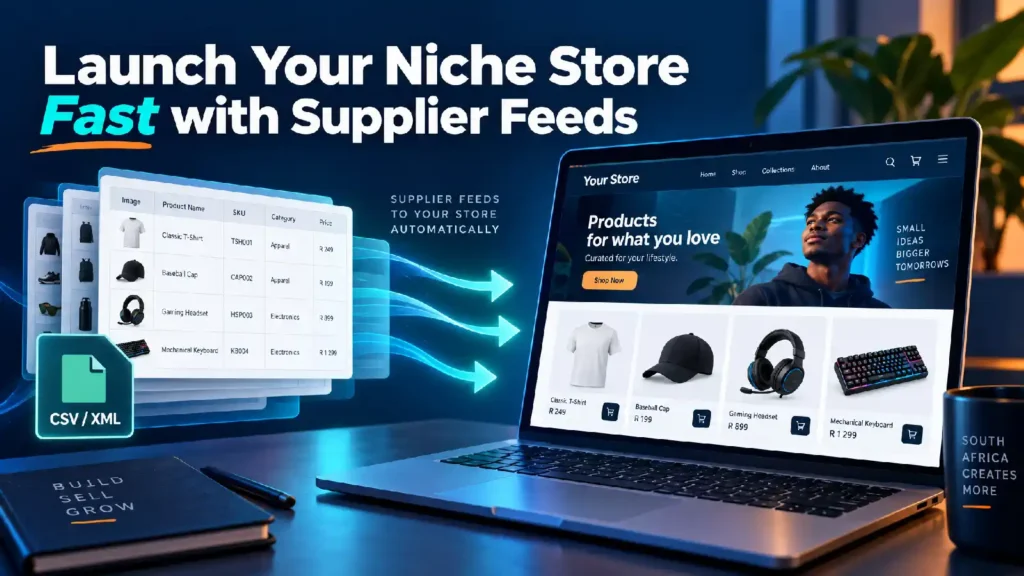
The Readers Warehouse eCommerce Success Story
From Garage Sale to Retail Titan: The Readers Warehouse Story How a South African family-owned bookseller’s commitment to affordable reading offers practical inspiration for first-time...
Read More →














30 Products
The best eCommerce website design practices for businesses in Johannesburg and Cape Town are to build a fast, mobile-first, secure, and conversion-focused online store that is designed for the South African market.
A successful eCommerce website should make it easy for customers to browse products, compare options, trust the business, and complete a purchase without friction.
For South African businesses, eCommerce website design should not only look professional. It should also be built to rank in Google, answer customer questions, support local payment methods, and convert website visitors into paying customers.
The most popular eCommerce platforms used by businesses in South Africa include WooCommerce, Shopify, Magento / Adobe Commerce, Wix, BigCommerce, and custom-built eCommerce websites. However, for many South African businesses, WooCommerce is often the most cost-effective and flexible option.
Shopify is a popular global eCommerce platform, but it is priced in US dollars. This can make Shopify costly for South African businesses because monthly platform fees, app fees, and third-party costs are affected by the USD to ZAR exchange rate.
WooCommerce is different because it is open source and built on WordPress. The WooCommerce plugin itself is free, which makes it a more cost-effective solution for many South African businesses. While businesses still need to pay for hosting, website development, maintenance, security, and selected plugins, WooCommerce gives more control over costs and can often be quoted, developed, and maintained in South African rand.
Magento / Adobe Commerce, Wix, and BigCommerce are also widely known eCommerce platforms, but they may not always be the most favourable option for the South African market. Many of these platforms use US dollar-based or international pricing models, which can become expensive when converted to ZAR.
Another important factor is payment gateway integration. Not every international eCommerce platform has ready-made, off-the-shelf plugins for all South African payment gateways. Businesses should check whether their chosen platform supports local card payments, instant EFT, buy-now-pay-later options, mobile payments, and South African merchant services.
For many South African businesses, WooCommerce is a strong choice because it is open source, cost-effective, SEO-friendly, flexible for custom development, and easier to adapt for local payment gateway requirements.
WooCommerce can be a better option than Shopify for many South African businesses that want a cost-effective, flexible, and locally adaptable eCommerce solution.
Shopify is priced in US dollars, which can make monthly fees, paid apps, themes, and third-party tools expensive when converted to South African rand. This can increase the long-term cost of running an online store in South Africa.
WooCommerce is open source, which means the core plugin is free. Businesses still need to budget for hosting, development, maintenance, security, and selected plugins, but WooCommerce gives greater control over costs and customisation.
WooCommerce is also flexible for South African payment gateway integration. Because it runs on WordPress and has a large developer ecosystem, it can often be adapted more easily for local payment gateways, custom checkout requirements, courier integrations, and SEO-focused content strategies.
An eCommerce website in Johannesburg or Cape Town usually takes between 1 and 3 weeks to develop, depending on the size and complexity of the project.
The timeline depends on the number of products, product categories, design requirements, payment gateway integration, shipping rules, content writing, SEO setup, product images, legal policy pages, and any custom functionality required.
To speed up development, businesses should prepare product images, product descriptions, pricing, delivery information, refund rules, privacy policy details, company information, and preferred payment gateway details before the project starts.
The main legal requirements for running an eCommerce website in South Africa include complying with the Electronic Communications and Transactions Act, POPIA, the Consumer Protection Act, tax rules, payment security requirements, and clear website policies.
South African eCommerce businesses should provide customers with transparent information before they buy. This includes accurate product descriptions, clear pricing, delivery costs, refund rules, cancellation terms, business contact details, and secure payment options.
This information is general guidance only. South African businesses should get professional legal advice to make sure their eCommerce website, terms, policies, and online sales process comply with applicable laws.
To market an eCommerce website effectively in Johannesburg and Cape Town, businesses should use a combination of local SEO, Google Ads, social media marketing, email marketing, content marketing, retargeting, and conversion optimisation.
The goal of eCommerce marketing is not only to get more visitors. The goal is to attract the right buyers, build trust, reduce friction, and increase online sales.